
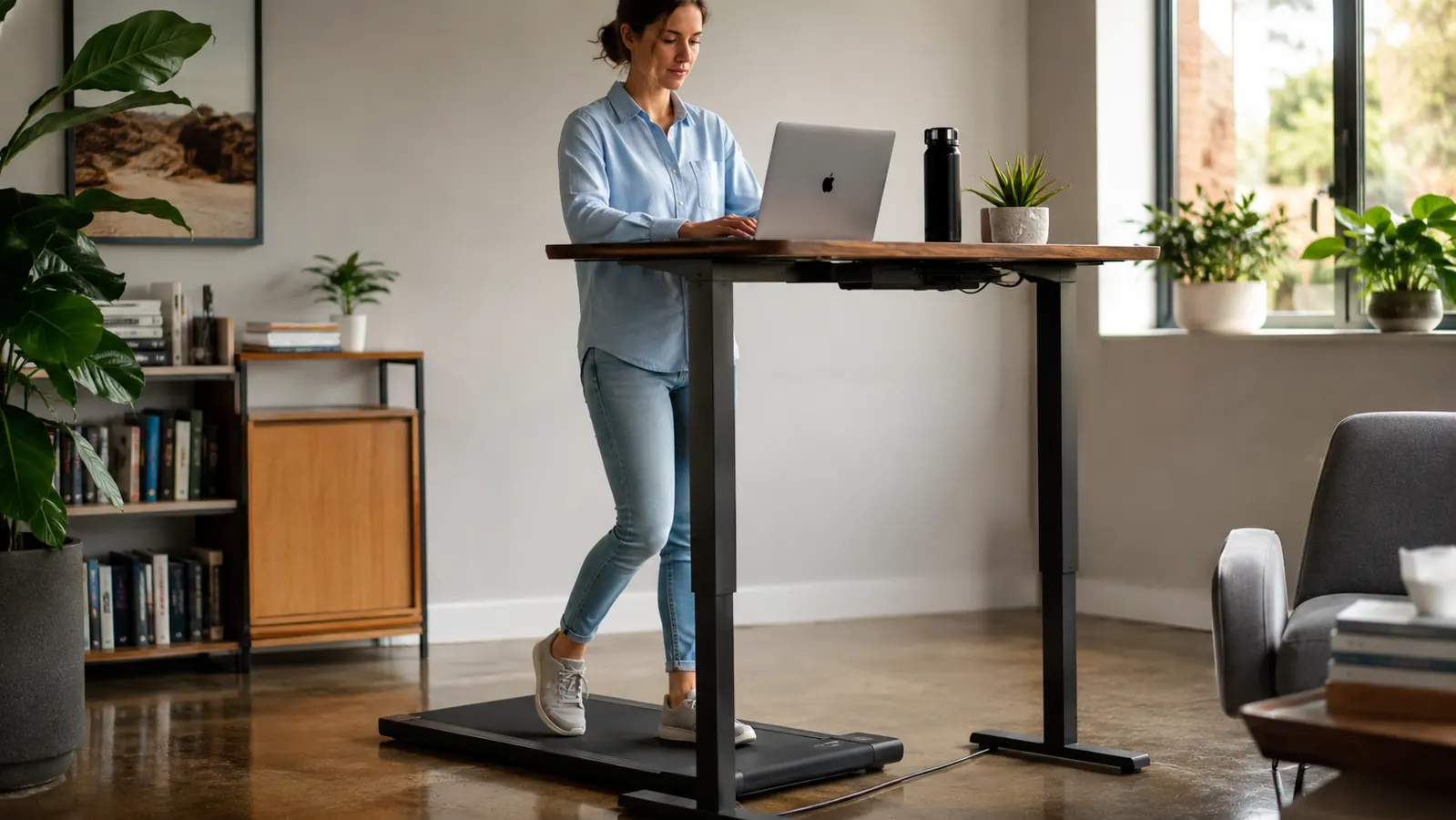
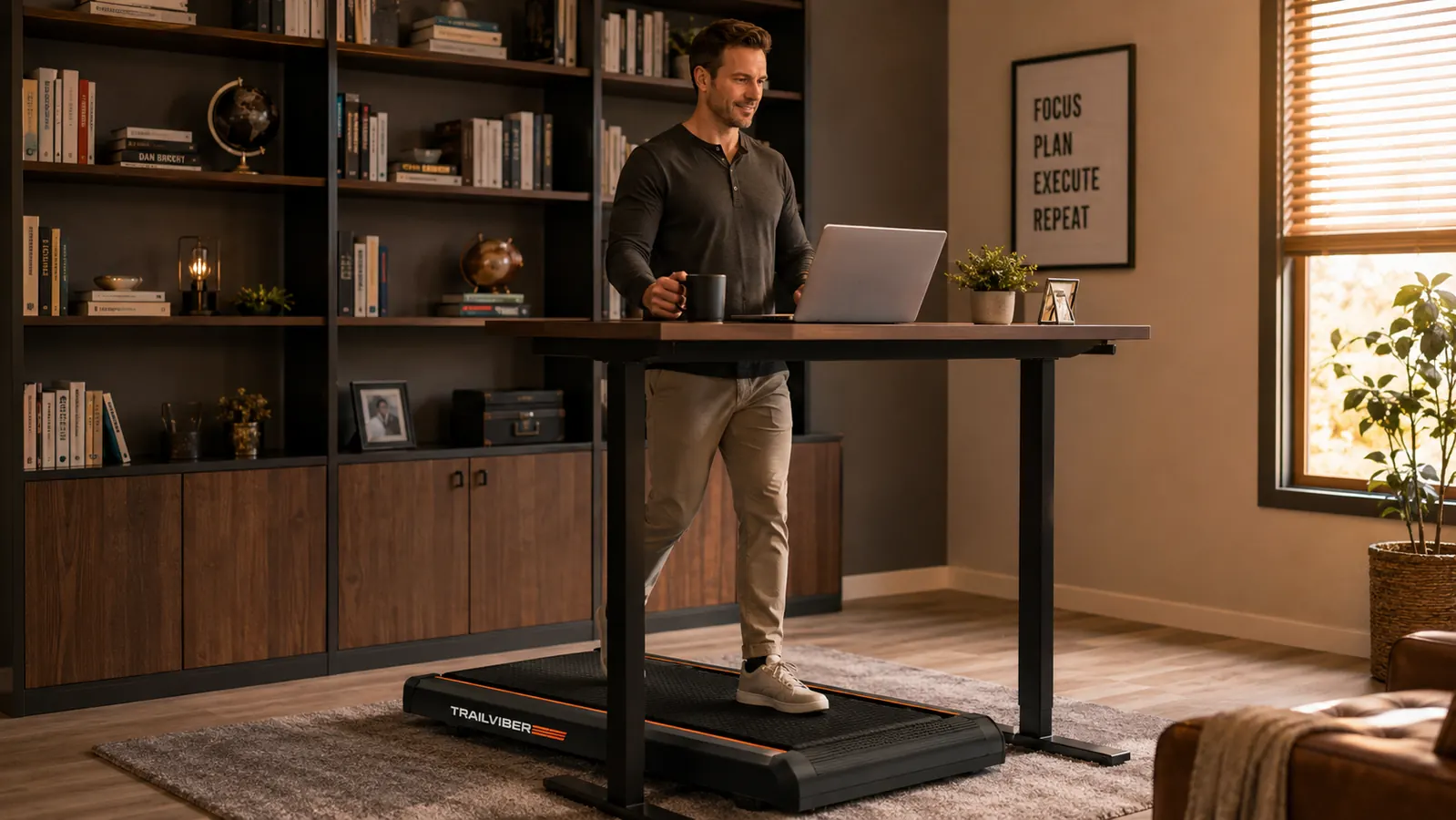
By February of this year I had accepted that I was basically sedentary during the workday. I work from home full time, and most days I would sit down at 8:30 in the morning and barely move until lunch. Then barely move again until dinner. My lower back ached. My afternoons felt like I was pushing through wet cement. My step count on workdays was sitting around 1,800. A colleague mentioned she had put a walking pad under her standing desk six months earlier and it had genuinely changed her energy levels. I was skeptical but curious, so I started researching. After about two weeks of reading reviews and comparison specs, I landed on the TRAILVIBER walking pad, ASIN B0D6BFMNN5, rated 4.7 stars across nearly 2,000 reviews. I placed the order on March 3rd. This is what three months of daily use looks like from the inside.
I want to be upfront about my setup before we go further. I have an adjustable standing desk I bought two years ago. I am 5 feet 11 inches, 185 pounds. My workday runs eight to nine hours. I was not training for anything. My goal was simply to stop being a human chair anchor for eight hours a day. That context matters because if you are looking for a serious cardio machine or a running treadmill, this is not that. The TRAILVIBER tops out at 4 mph, which means brisk walking is about the ceiling. But for under-desk work use, that is exactly right.
The Quick Verdict
A genuinely well-built walking pad that delivers on its core promise. The auto-incline is useful, the noise level is manageable, and three months in I am consistently hitting 7,000 to 9,000 steps on workdays. Not for everyone, but for remote workers who can spare the floor space, it is one of the better upgrades I have made to this desk.
Amazon Check Today's Price →Sitting eight hours a day is the problem. This is the fix that lives under your desk.
The TRAILVIBER walking pad fits most standing desks, holds up to 450 lbs, and ships with a remote so you never have to step off to change speed. Check the current price on Amazon before the next price shift.
Amazon Check Today's Price on Amazon →How I Have Used It Over Three Months
My routine settled into something consistent by the end of week two. I walk at 1.5 to 2.0 mph during calls, emails, and anything that does not require intense focus. When I am writing or doing deep work, I either slow it to 1.0 mph or step off entirely. I do not walk every hour of every day. On most days I log two to four walking sessions totaling about 90 minutes of actual pad time. By the end of March my average workday step count had climbed from 1,800 to just over 6,000. By the end of May it was sitting consistently above 8,000.
The learning curve was real but short. The first three or four days I felt slightly unsteady, the way you feel when you get off a boat and the ground still seems to move. I also typed slower and made more typos during the first week. By day ten that had almost entirely resolved. I type at my normal speed while walking at 1.5 mph now with no meaningful difference in accuracy. If you are buying this expecting zero adjustment period, that is not realistic. Give it two weeks.
I also experimented with the auto-incline feature over several weeks. The TRAILVIBER offers nine incline levels up to 12 percent. At a 1.5 to 2.0 mph walking pace, even a 6 or 8 percent incline introduces a noticeably different load on your legs and glutes. I settled into using levels 3 through 5 during morning sessions and dropping back to level 1 or flat for afternoon calls. The incline transitions smoothly and quietly. No jarring drop or jump. That matters more than I expected.
Build Quality and the 450-Pound Capacity Claim
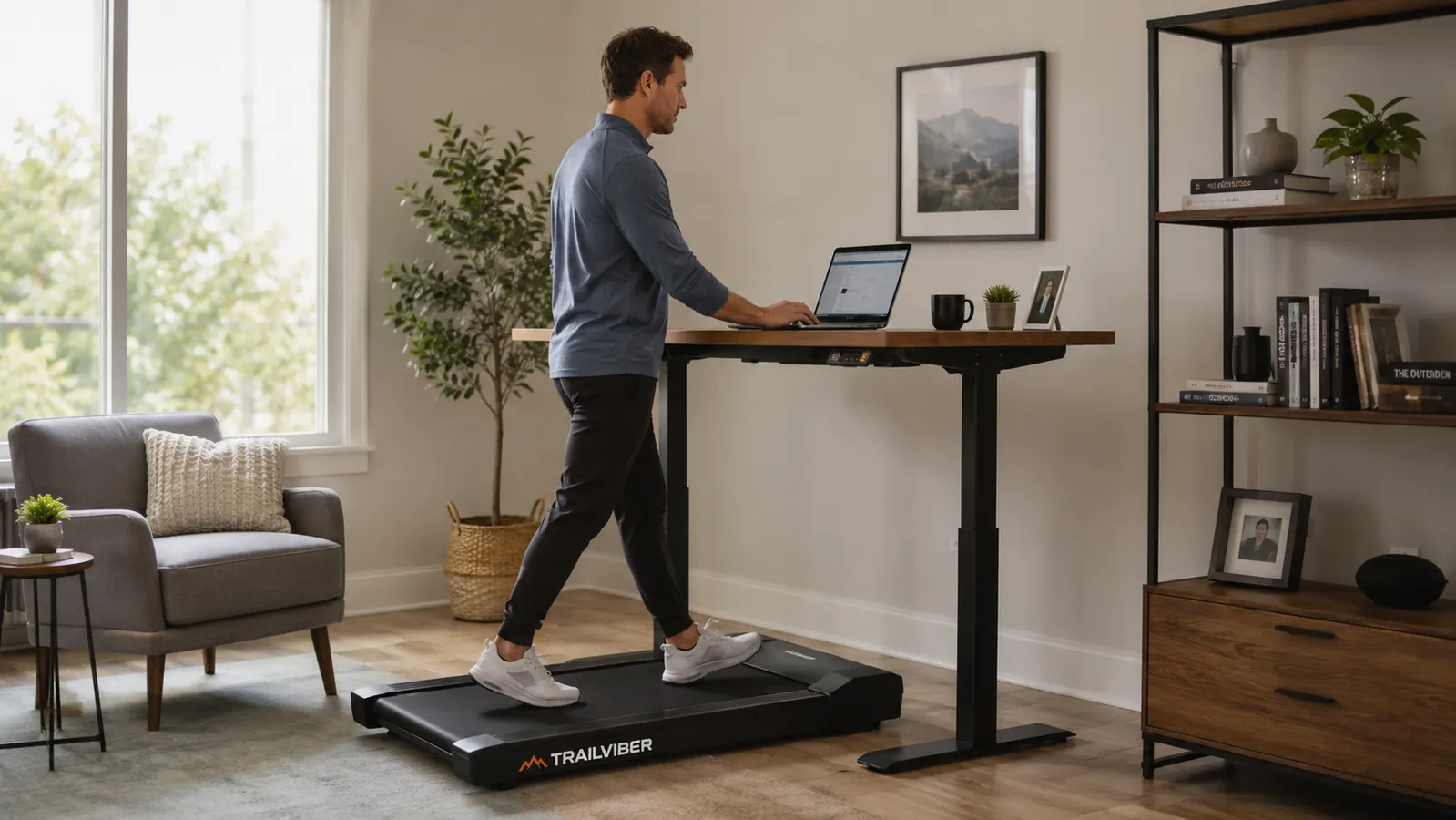
The TRAILVIBER arrived in a single large box and took me about 15 minutes to unpack and unfold. Setup is minimal. The unit comes pre-assembled. You unfold it, confirm the belt is centered, plug it in, and it is ready. At 62 pounds it is not light, but the built-in transport wheels make moving it manageable for one person.
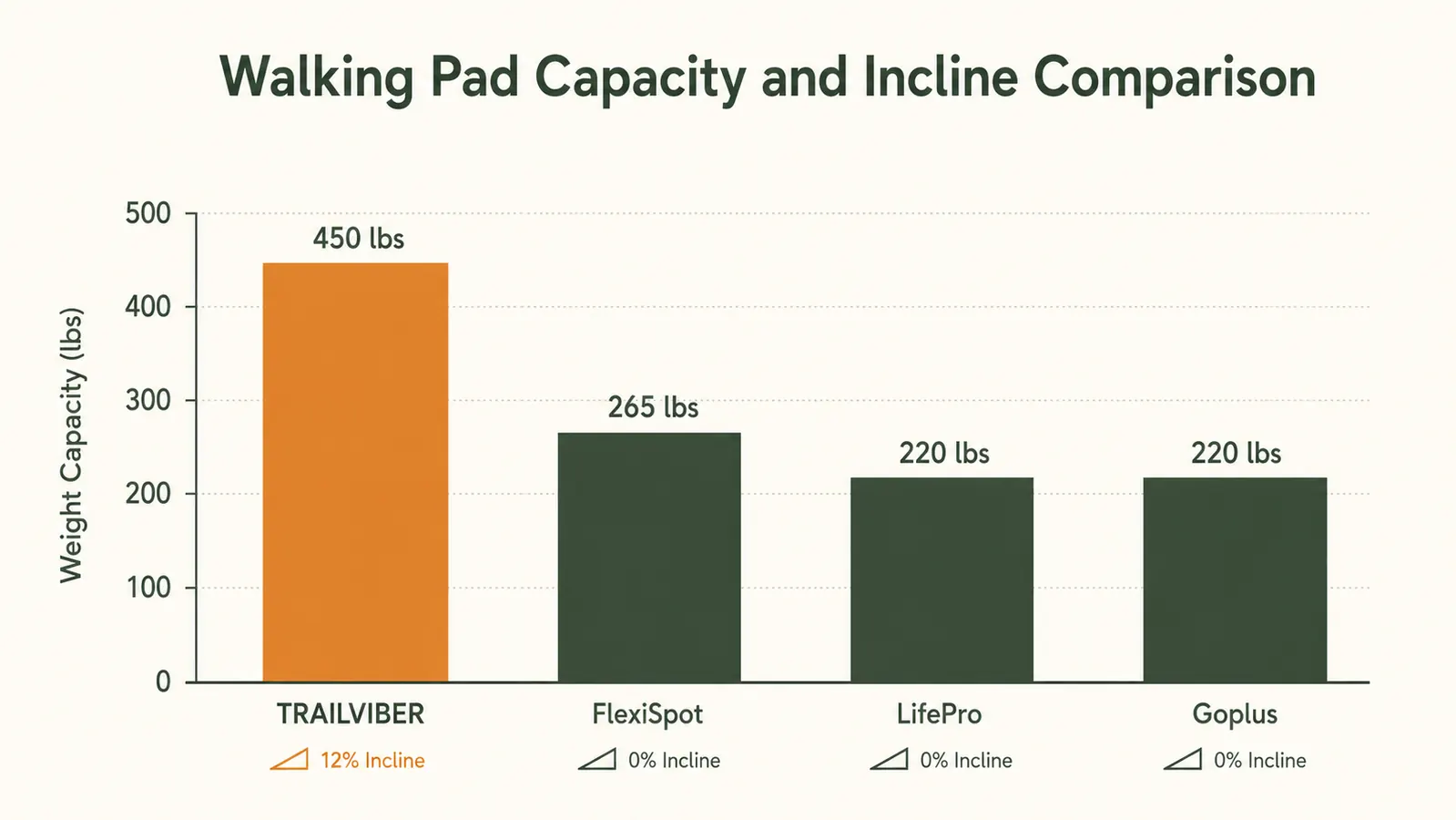
The deck feels solid underfoot. There is no flex or wobble at any speed. The belt surface has a textured grip finish that holds sneakers well and has not shown any visible wear after three months of daily sessions. The side rails are raised enough to feel safe without being high enough to interfere with your normal walking stride. At my weight of 185 pounds the machine has never groaned, hesitated, or behaved like it was working hard. The 450-pound weight capacity is not a marketing number I would question based on build quality alone.
The motor runs at around 50 to 60 decibels at 2.0 mph on a hard floor, roughly the volume of a quiet conversation in the same room. On carpet it is a few decibels quieter. I work with a headset during calls and nobody has ever mentioned hearing the belt. Without a headset, the ambient hum is noticeable but not distracting. It is quieter than I expected and noticeably quieter than other walking pad options I tested briefly at a gym that stocks them.
The Remote Control Is More Important Than You Think
The TRAILVIBER ships with a small handheld remote that clips to your waistband or can sit on your desk. You can start, stop, speed up, and slow down without looking away from your screen or bending down to the control panel on the unit. This sounds minor until you are in the middle of taking notes on a call and need to drop from 2.0 to 1.0 mph quickly. The remote makes that a one-button action.
The display panel on the unit itself shows speed, time, distance, and calories. It is useful for a quick glance but not large enough to read comfortably from standing desk height without leaning in. I rely on the remote for speed adjustments and check the panel once or twice per session. If you are trying to hit a specific distance or time target, a fitness tracker on your wrist is a better companion than the built-in display.
By week six, my 3 pm energy crash had basically disappeared. I was not expecting that. I thought walking at work would make me more tired, not less. The opposite turned out to be true.
What Actually Changed After Three Months
The energy improvement is the thing I talk about most when someone asks whether this was worth it. I had a reliable afternoon slump that hit around 3 pm every workday. By week six that slump was mostly gone. I suspect the combination of increased blood flow, more daily movement, and the gentle mental stimulation of walking kept my focus steadier across the afternoon. I cannot point to a controlled study on my own body, but the pattern is consistent and it has not gone away.
Lower back pain was my second reason for buying this. After two years of working at a desk, I had developed a dull chronic ache in my lumbar region that I managed with stretching and occasional ibuprofen. After about six weeks on the walking pad, that ache dropped from a regular 6 out of 10 annoyance to occasional 2 or 3 flare-ups on days when I sit unusually long. It has not eliminated the problem entirely, but it has made a real difference. I sit less because walking is an alternative, and that alone helps.
Productivity was the thing I was most worried about. I was convinced I would be distracted, slower, or more prone to mistakes while walking. That concern faded within two weeks. Email, Slack, most calls, reading, and anything that does not require me to compose complex documents or code works fine at 1.5 to 2.0 mph. For writing or analytical work I slow to 1.0 mph or step off. The split is probably 60 percent walking, 40 percent standing still, with very little seated time anymore.
Storage, Space, and Desk Compatibility
The TRAILVIBER folds upright for storage. Folded, it stands about 6 inches deep and leans against a wall. That is genuinely compact for a machine this capable. I store it beside my desk when I am not using it and slide it out in under 30 seconds. If you do not have a garage or dedicated workout space but do have a home office with a few feet of wall clearance, storage is not a problem.
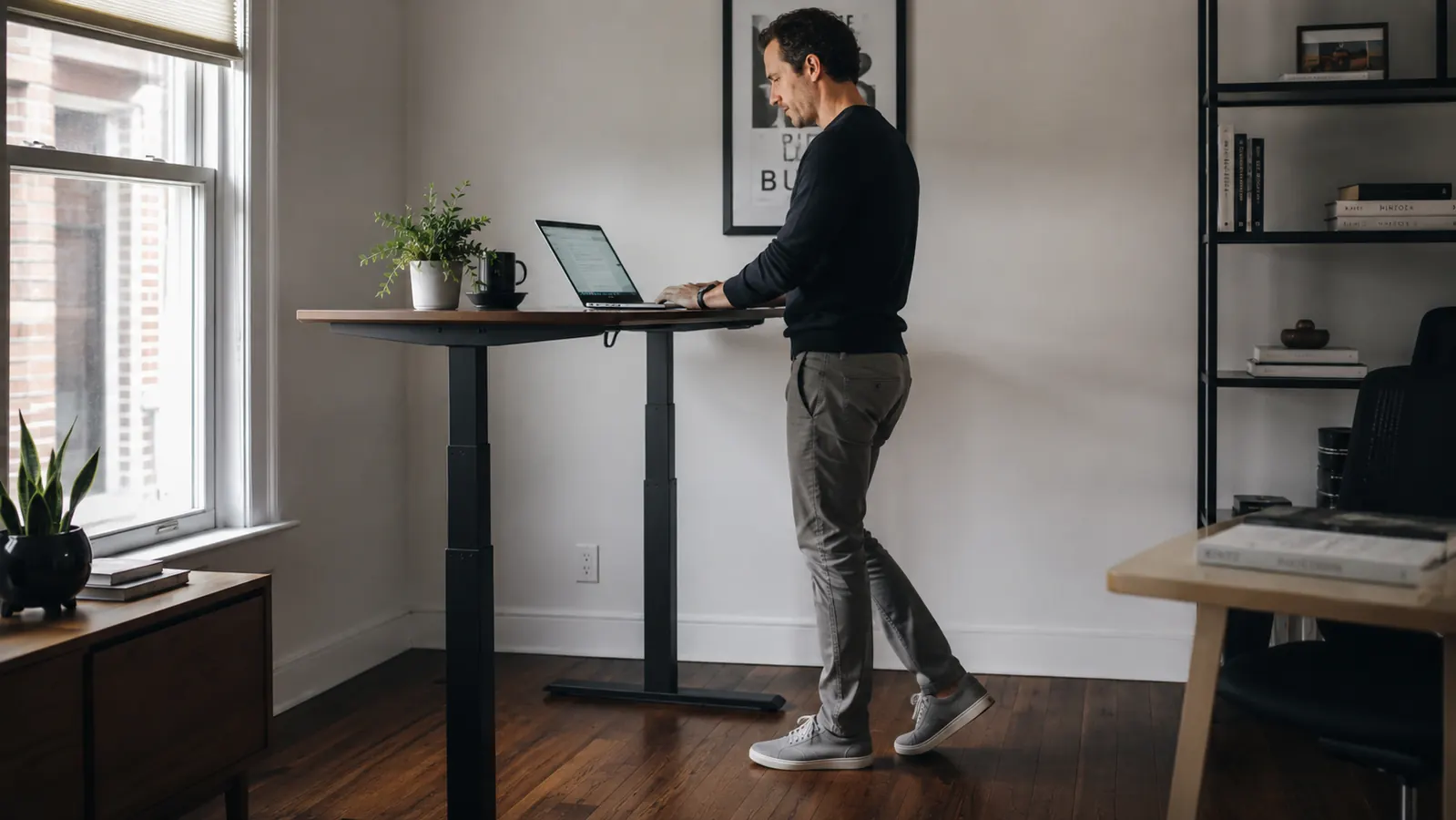
Desk compatibility is the most common concern I see in forum discussions. The TRAILVIBER requires that your desk surface be at least 43 inches from the floor when raised to standing height. Most adjustable standing desks hit 43 to 50 inches at max height, so compatibility is usually fine. If you have a fixed-height desk at the standard 30-inch sitting height, a walking pad is not going to work for you. You need the standing desk. If you are still weighing that choice, the comparison article on walking pads versus standing desk mats covers the tradeoffs in more detail.
Where It Falls Short
The TRAILVIBER is not perfect. The app connectivity is optional and the iOS app I tried was functional but basic. You can log sessions and see historical data, but the interface feels dated and I stopped using it after the first month in favor of just tracking steps on my Apple Watch.
The unit does not have a built-in incline memory. If you set up a specific incline level you like for morning sessions, you will set it manually each time. It remembers your last speed but not the incline angle. That is a minor annoyance rather than a dealbreaker, but worth knowing.
At around 62 pounds, the machine is also not something you will be casually moving from room to room. The transport wheels help but the weight is real. If you need to relocate it frequently, factor that in. This is a product that lives in one room and stays there.
What I Liked
- Quieter than expected at typical under-desk walking speeds of 1.5 to 2.0 mph
- Auto-incline up to 12 percent adds meaningful calorie burn without requiring faster speed
- Remote control makes speed adjustments hands-free during calls or typing
- 450-pound capacity and solid deck construction with no flex at normal use weights
- Compact upright folding storage takes minimal wall space
- Genuine energy improvement through the afternoon after six to eight weeks of regular use
Where It Falls Short
- App is functional but dated and not worth relying on as a primary stats tracker
- Incline setting does not save between sessions, must be manually reset each time
- 62 pounds makes room-to-room relocation inconvenient despite the transport wheels
- Requires a standing desk or adjustable desk to use, not compatible with a fixed sitting desk
Who This Is For
The TRAILVIBER walking pad makes the most sense for remote workers or home-based freelancers who already have an adjustable standing desk and are genuinely concerned about how sedentary their workday has become. If your step count is regularly below 3,000 on workdays, you will feel the improvement within a few weeks. If your back aches from long sitting sessions and you have already tried a better chair or a mat without enough relief, the problem is not the chair. The problem is that you are sitting too much. This is the tool that solves that.
It also works well for people who have found standing desks alone to be less effective than advertised. Standing all day is better than sitting all day, but it is still not moving. The walking pad converts standing time into light movement that actually changes how your body feels by end of day. If you want more depth on why movement beats stationary standing, the article on 10 reasons an under-desk treadmill changes your workday goes into each benefit separately.
Who Should Skip It
If you have a fixed-height desk at sitting height, skip this for now and sort out the standing desk situation first. A walking pad under a desk that is too low will wreck your posture faster than sitting does. If you are in a shared apartment where noise is a serious concern and the walls are thin, the belt hum at walking speeds might create friction with neighbors in close quarters. Not everyone's space accommodates this. And if you are hoping for a cardio workout, this is not going to get your heart rate up in any meaningful way. This is a low-intensity movement tool for a sedentary workday, not a fitness machine.
Three months in, I would buy the TRAILVIBER again without hesitating. Here is where to check current pricing.
The TRAILVIBER walking pad ships fast and most orders arrive in three to five days. The auto-incline feature and 450-pound capacity make it one of the better-built options in this price range. See what it is selling for today on Amazon.
Amazon Check Today's Price on Amazon →